
Project Lead
Dr. Claudia Hildebrand
+49 721 608 - 47955
Claudia Hildebrand∂kit edu


The SUST(R)AINPRO-KIT project aims to establish and expand sustainable structures at KIT in order to promote the mental health of doctoral candidates and reduce psychological stress. As existing services at KIT primarily focus on acute counseling and crisis intervention (secondary/tertiary prevention), the project concentrates on primary prevention in the area of mental health. The aim is to systematize existing internal and external services and build a network of stakeholders and target groups in order to establish long-term health-promoting structures. This early prevention should help to increase the well-being and life satisfaction of doctoral students and relieve the burden on mental health contact points at KIT and in the surrounding area.
Strong doctorate - healthy research: That is the goal of SUST(R)AINPRO-KIT. The project follows the intervention mapping approach and the PDCA cycle (Plan-Do-Check-Act) and is divided into three central sub-projects.
1. needs and requirements analysis (SP1): First, mental health, stress factors and resources of doctoral students are collected by means of surveys, focus groups, interviews, research of existing data and at the same time existing offers within and outside the KIT are systematized.
2. target definition and intervention plan (TP2): The first step is to define specific and long-term goals. Preventive measures are planned in the theory- and evidence-based intervention planning. The measures are developed in a participatory manner together with the target group and the relevant stakeholders.
3. implementation and evaluation (SP3): This is followed by the implementation of a suitable measure. The effectiveness is evaluated using qualitative and quantitative methods (e.g. RE-AIM framework). Finally, improvements and potential transferability to other status groups are derived.
Prof. Dr. Kathrin Wunsch

+49 721 608 - 45431
Kathrin Wunsch∂kit edu
Prof. Dr. Alexander Woll

+49 721 608 - 41661
Alexander Woll∂kit edu
Karolin Schmid
Karolin Schmid∂kit edu
Dr. Claudia Hildebrand

+49 721 608 - 47955
Claudia Hildebrand∂kit edu
Dr. Philip Bachert

+49 721 608 - 42484
Philip Bachert∂kit edu

The New Balance project aims to identify the effects of mobile and digital working arrangements on health, work–life balance, and self-perceived productivity.
To ensure a practice-oriented and realistic project design, the project team identifies groups at KIT who experience particular challenges in balancing work or studies with private life. Based on these vulnerable groups, representative personas are developed.
Examples include researchers and students with caregiving responsibilities, first-year students, and early-career researchers facing high workloads and career pressures, often alongside family-related demands.
The results report of the 2023/2024 online survey is available here.
Milestone 1 (2024) – Online Survey:
Analysis of protective and risk factors considered relevant for promoting health, satisfaction with work–life balance, and self-perceived productivity, based on a representative sample of employees and students.
Milestone 2 (2025) – Ambulatory Assessment:
In-depth analysis of the relationships among the factors identified in Phase 1 within the framework of an everyday-life observational study. The real-life observational study will begin in spring 2025.
Prof. Dr. Alexander Woll
+49 721 608 - 41661
Alexander.Woll∂kit.edu
Dr. Claudia Hildebrand

+49 721 608 - 47955
Claudia Hildebrand∂kit edu
Dr. Philip Bachert
+49 721 608 - 42484
Philip Bachert∂kit edu
Dr. Marco Giurgiu

+49 721 608 - 41974
Marco Giurgiu∂kit edu
Dr. Kathrin Wunsch

+49 721 608 - 45431
Kathrin Wunsch∂kit edu
Svenja Sers

Svenja Sers∂kit edu
Dr. med. Andrea Stahl

+49 721 608 22068
andrea stahl∂kit edu
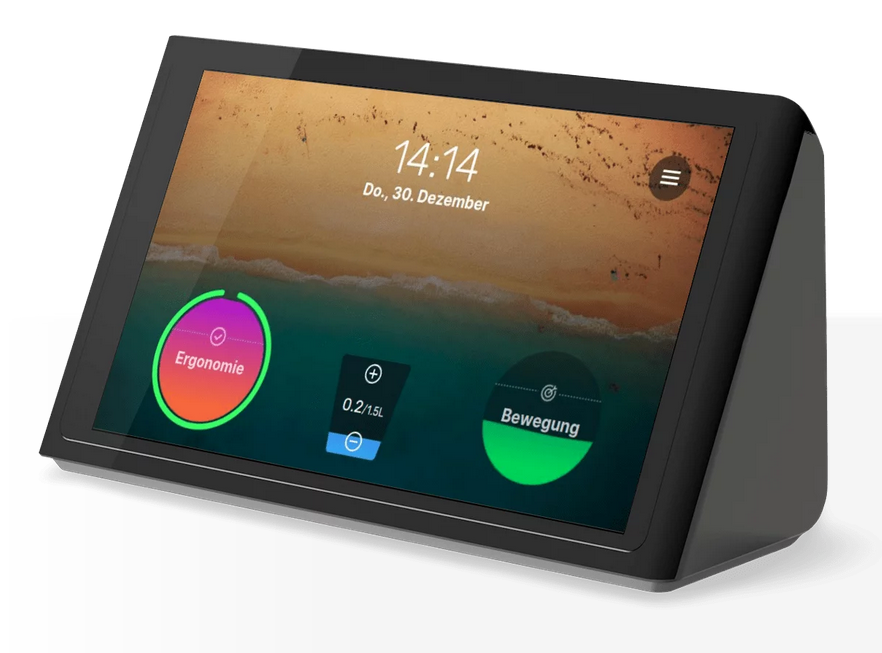

The SMIGAA project aims to (further) develop and evaluate an intelligent and digital health assistant. This health assistant is intended to contribute to ergonomic sitting and regular exercise breaks while working at a desk by using a depth sensor to recognize the user's sitting posture and making real-time posture corrections and individual suggestions for exercise.
The further development includes improving user interaction with the health assistant through the implementation of behavior change techniques, as well as integrating personalized user addressing to ensure sustained usage. In addition, specific compensatory exercises will be developed based on the detection of highly strained body regions. The evaluation will be conducted within a controlled effectiveness study.
Furthermore, the sensor technology of the health assistant enables, for the first time, the collection of extensive data on the health behavior of employees in desk-based workplaces, going far beyond, for example, accelerometer data. The resulting insights are intended for publication and may be used in the future to adapt interventions to actual behavior patterns.
The project focuses on the following research questions:
How must human–technology interaction be designed to achieve long-term behavioral change among employees who predominantly work at desks?
Is the product developed within the SMIGAA project effective and easy to integrate into everyday work routines?
Milestone 1: User-centered further development of ISA (completed 01/2025)
Milestone 2: Effectiveness analysis (completed early 2026)
Prof. Dr. Alexander Woll

+49 721 608 - 41661
Alexander.Woll∂kit.edu
Dr. Claudia Hildebrand

+49 721 608 - 47955
Claudia.Hildebrand∂kit edu
Jonathan Diener

+49721 608 - 41736
Jonathan.Diener∂kit.edu

The nationwide model project PROCARE, funded by Techniker Krankenkasse (TK), aims to develop movement science–based recommendations for preventive strategies and practical implementation guidelines in residential care settings over a three-year project period.
The objective is to implement a needs-based prevention program in accordance with §5 SGB XI within residential care facilities, taking into account the specific organizational and operational conditions of each institution. The program is designed to address both nursing staff and care recipients.
Under the joint leadership of the University of Hamburg and Techniker Krankenkasse, researchers at eight university locations across Germany are implementing the multi-component intervention program in six care facilities per site. In total, 48 (partially) residential care facilities are currently being supported and scientifically monitored to evaluate the feasibility and effectiveness of the program.
Project group: Social and Health Sciences
Funding: Techniker Krankenkasse (TK); IN FORM
Project start: 2018
Project end: 2021
A distinctive feature of the PROCARE project is its comprehensive approach, aiming to consider all relevant groups within a nursing care facility. Accordingly, the program components target both employees (nursing staff, social care, housekeeping, administration) and care recipients.
For employees, the multicomponent program primarily focuses on physical activity, ergonomics, back-friendly working techniques, and back fitness. For care recipients, the emphasis is placed on movement training, cognitive training, and psychosocial well-being.
Intervention for Employees
Within the randomized controlled trial, questionnaire data are collected at four measurement time points: baseline, after 10 weeks, after 22 weeks, and at a 34-week follow-up. The primary endpoints include the following parameters:
Workplace stressors (Questionnaire on Subjective Assessment of Workplace Stressors; Slesina, 2009)
Musculoskeletal complaints (Nordic Musculoskeletal Questionnaire; Caffier et al., 1999)
Physical and mental health composite scores (SF-12 Health Survey; Bullinger et al., 1995)
Chronic stress (Trier Inventory for Chronic Stress – TICS; Schulz & Schlotz, 1999)
Work-related behavior and experience patterns (AVEM; Schaarschmidt & Fischer, 2008)
The intervention for employees consists of two phases. Following the baseline assessment, participants complete a posture and ergonomics training program (10 weeks, once per week, 20–30 minutes), covering key topics such as workplace organization, patient handling and positioning, and the use of assistive devices.
The second phase involves a back fitness training program (12 weeks, once per week, 45–60 minutes), incorporating elements of mobility, coordination, strength development, and relaxation.
Intervention for Care Recipients
The intervention for care recipients centers on a 16-week group-based physical activity program (twice per week, 45–60 minutes). The program includes exercises designed to improve strength, endurance, balance, mobility, and cognitive functioning.
The intervention is framed by baseline and post-intervention assessments, including the following measures:
Lower extremity functionality and mobility (Short Physical Performance Battery – SPPB; Guralnik et al., 1994)
Subjective physical and mental well-being (SF-12; Bullinger & Kirchberger, 1998)
Life satisfaction (Satisfaction With Life Scale – SWLS; Glaesmer et al., 2011)
Affective status and depressive symptoms (CES-D; Radloff, 1977)
Cognitive impairment and dementia screening (Montreal Cognitive Assessment – MoCA; Nasreddine et al., 2005)
Fall-related self-efficacy (Falls Efficacy Scale – FES-I; Hauer et al., 2011)
Activities of daily living (Barthel Index; Mahoney & Barthel, 1965)
Frailty (Frailty Phenotype; Fried et al., 2001)
Study Protocol for Care Recipients
PROCARE Gets People Moving
Within the PROCARE project for residential long-term care facilities, the health of both employees and residents is addressed equally. While nursing staff receive tailored interventions focusing on back fitness, ergonomics, and stress management, targeted programs for care recipients are designed to strengthen their cognitive and physical mobility. This, in turn, also reduces strain on caregiving staff. Ultimately, both groups benefit in terms of health-related well-being and day-to-day interactions.
Selected Publications:
Bebenek, M., Zwingmann, K., Panter, L., Appelles, LM., Thorenz, K., Hildebrand, C., Cordes, T., Otto, AK., Oliver Vogel, Bischoff, L. & Wollesen, B. (2020). Was hält die Pflege gesund? – Welchen Beitrag kann Prävention und Gesundheitsförderung leisten? Herausgeber M. Bebenek, Institut für Medizinische Physik Friedrich-Alexander-Universität Erlangen/Nürnberg. in Kooperation mit der Techniker Krankenkasse. Download unter: https://www.tk.de/lebenswelten/gesunde-pflege/procare-praevention-stationaer-2135698
Korbus, H.; Hildebrand, C.; Schott, N.; Bischoff, L.; Otto, A.-K.; Jöllenbeck, T.; Schoene, D.; Voelcker-Rehage, C.; Vogt, L.; Weigelt, M.; Wollesen, B. (2023). Health Status, Resources, and Job Demands in Geriatric Nursing Staff: A Cross-Sectional Study on Determinants and Relationships. International journal of nursing studies, 145, Article no: 104523. doi:10.1016/j.ijnurstu.2023.104523
Wollesen, B.; Schott, N.; Klotzbier, T.; Bischoff, L. L.; Cordes, T.; Rudisch, J.; Otto, A.-K.; Zwingmann, K.; Hildebrand, C.; Joellenbeck, T.; Vogt, L.; Schoene, D.; Weigelt, M.; Voelcker-Rehage, C. (2023). Cognitive, physical and emotional determinants of activities of daily living in nursing home residents—a cross-sectional study within the PROCARE-project. European Review of Aging and Physical Activity, 20 (1), Art.Nr.: 17. doi:10.1186/s11556-023-00327-2
Otto, A.-K.; Pietschmann, J.; Appelles, L.-M.; Bebenek, M.; Bischoff, L. L.; Hildebrand, C.; Johnen, B.; Jöllenbeck, T.; Kemmler, W.; Klotzbier, T.; Korbus, H.; Rudisch, J.; Schott, N.; Schoene, D.; Voelcker-Rehage, C.; Vogel, O.; Vogt, L.; Weigelt, M.; Wilke, J.; Zwingmann, K.; Wollesen, B. (2020). Physical activity and health promotion for nursing staff in elderly care: a study protocol for a randomised controlled trial. BMJ open, 10 (10), Art. Nr.: e038202. doi:10.1136/bmjopen-2020-038202
Cordes, T.; Bischoff, L. L.; Schoene, D.; Schott, N.; Voelcker-Rehage, C.; Meixner, C.; Appelles, L.-M.; Bebenek, M.; Berwinkel, A.; Hildebrand, C.; Jöllenbeck, T.; Johnen, B.; Kemmler, W.; Klotzbier, T.; Korbus, H.; Rudisch, J.; Vogt, L.; Weigelt, M.; Wittelsberger, R.; Zwingmann, K.; Wollesen, B. (2019). A multicomponent exercise intervention to improve physical functioning, cognition and psychosocial well-being in elderly nursing home residents: a study protocol of a randomized controlled trial in the PROCARE (prevention and occupational health in long-term care) project. BMC geriatrics, 19 (1), Article no: 369. doi:10.1186/s12877-019-1386-6