
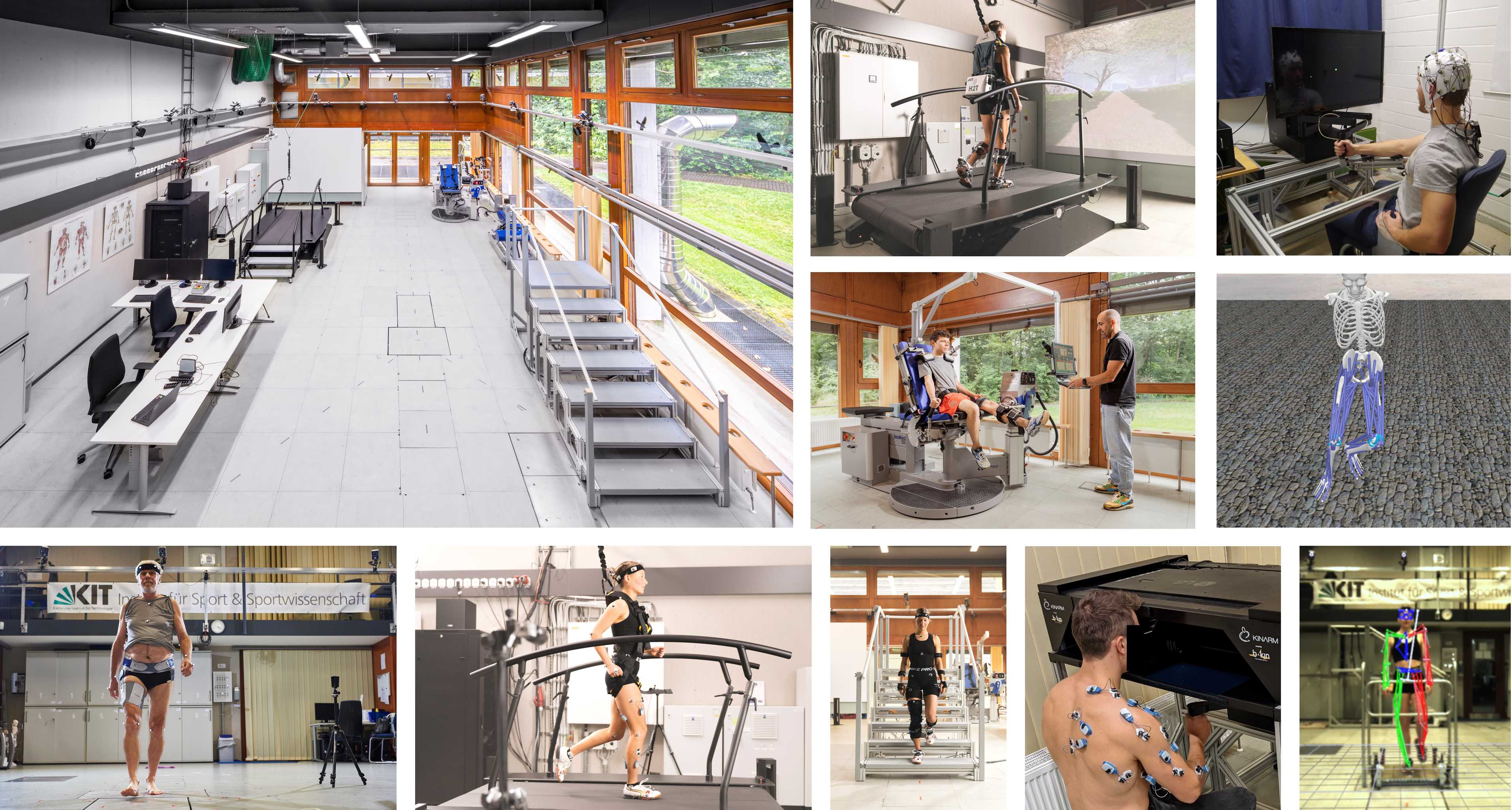
Movement is fundamental to human life: it supports everyday function, contributes to health, and forms the foundation for any sporting activity. Our research investigates human movement at the interface of sport science, motor control, and biomechanics. The Biomechanics and Robotics Labs provide controlled experimental environments in which we study how movement emerges from the interplay between the nervous system and the musculoskeletal system, and how humans learn, adapt, and optimize motor behavior.
Labs
Biomechanics lab
The Biomechanics Lab enables the integrated investigation of human movement from biomechanical and motor control perspectives, including estimates of internal joint loading and measurements of muscle activity. Our experiments focus on functional and locomotor movements - such as standing up and sitting down, level and inclined walking and running, turning, stair walking, and cutting maneuvers - as well as balance tasks during standing and locomotion, including responses to trips and slips.
These movement domains are central to everyday life, health, and sport. Walking is essential for independent living but can become increasingly difficult with age or in the presence of musculoskeletal impairments such as osteoarthritis, potentially limiting mobility and quality of life. Running and rapid changes of direction are key components of performance in athletics, team sports, and many other sporting activities.
Balance control is equally relevant. In everyday life, impaired balance contributes to the risk of falls, which can result in injury, hospitalization, and loss of independence, particularly in older adults. In sport, balance is a central requirement in activities such as gymnastics, skiing, and surfing.
Studying locomotion and balance also provides an important basis for understanding human-technology interaction and for developing and evaluating technologies such as running shoes, orthoses and exoskeletons.
Robotics lab
The Robotics Lab houses two robotic interfaces, the KINARM End-Point Lab and the BioMotionBot. Participants grasp the endpoints of these systems and perform visually guided reaching tasks presented on a monitor or through an interactive virtual environment.
The robots can generate programmable forces and emulate different mechanical properties of objects. These properties can be modified in real time, requiring participants to adapt their movements while interacting with the robotic system. This resembles every day and sporting situations in which people must adjust to an unfamiliar tool or a new piece of sports equipment with different mechanical properties. The robotic interfaces therefore allow us to investigate fundamental mechanisms of upper-limb motor control and motor adaptation under precisely controlled conditions.
Open programming interfaces enable us to design a wide range of movement tasks and experimental conditions. High-precision sensors provide force and position data, while additional interfaces allow us to integrate methods such as electroencephalography and electromyography. By combining behavioral, mechanical, and neurophysiological data, we can investigate how the nervous system controls movement and adapts motor behavior to changing task and environmental demands.
Lab equipment
Motek Medical M-Gait Treadmill System
The M-Gait is 3D instrumented dual-belt treadmill with a VR interface that enables us to create diverse locomotion and balance tasks for our research.
Biomechanics
Measuring tools: 10 Vicon Vantage V8 cameras, 6 Vicon Vero v2.2 cameras, 2 Vicon Vue cameras, 2 Vicon Lock Lab with A/D converter (each 64 channels), Noraxon Ultium Motion IMU system, 4 force plates (AMTI & in-house development), instrumented stairs (in-house development), novel emed® pressure distribution plate, novel pedar® pressure distribution insole, novel pliance® pressure distribution on surfaces & IsoMed 2000 (D. & R. Ferstl GmbH)
Modeling tools: alaska/Dynamicus, OpenSim, Vicon Plug-In Gait & Motek Human Body Model
Neurophysiology
Noraxon Ultium wireless EMG system (16 channels), Noraxon Telemyo 2400TG2 EMG system (16 channels) & Brain Products EEG system (16 channels)
Postural Control
BIOSWING Posturomed (with in-house developed perturbation module), Lafayette Instrument 16030 stability platform (with in-house developed online feedback system), forward-fall simulation tool (in-house development) & brake-and-release tool to induce perturbations during walking (in-house development)
Robotic Interfaces
KINARM End-Point Lab (with Virtual Reality Display & lower arm support) & BioMotionBot (Bartenbach et al., 2013)
Exoskeleton
Auxivo LiftSuit 2.0